


Best Glasses for Small Face Shapes: Petite Frame Guide

Table of Contents
- Why Standard Frames Slip on a Small Face
- The Eyeglass Frame Size Guide: Numbers That Actually Fit
- Glasses for Narrow Faces: Width, Bridge, and Temple Fit
- Petite Glasses for Small Faces: Our Verified Shortlist
- Reading Glasses for Narrow Faces: What to Look For
- Prescription Lenses and Fit Problems in Petite Frames
- Conclusion
- Frequently Asked Questions
Last Updated: October 19, 2026
Why Standard Frames Slip on a Small Face
Most eyeglass frames are built for an average face, so a narrow face ends up swimming in frames that measure wider than the temples. The result is predictable: the glasses slide down the nose, the lenses sit too low, and the wearer spends the day pushing them back up. At The Optical Shop of Manhasset, we see this constantly with clients who have small features and a narrow profile. The fix is not a tighter screw or a grippier nose pad. It is choosing frames whose measurements match the face in the first place. Below, we break down the numbers, the fit points, and the best glasses for small face shapes that work, so you can stop guessing and start measuring.
How to Tell If Your Face Is Petite or Narrow
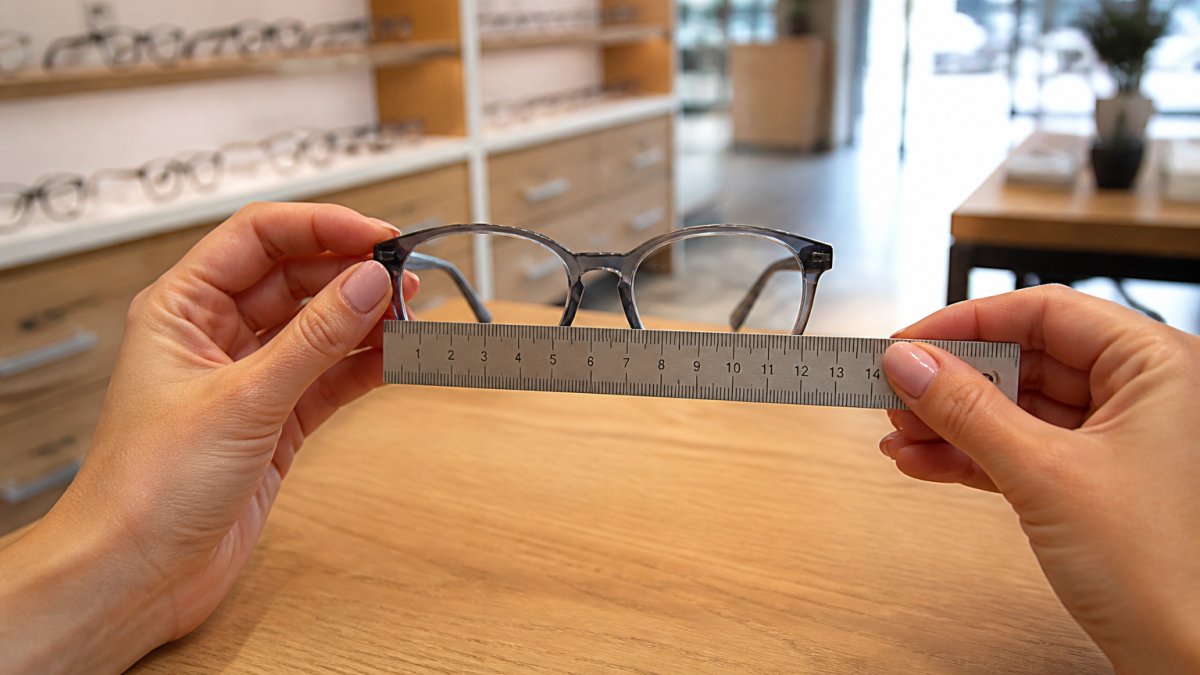
Your face is petite or narrow if the widest point across your temples measures roughly 130 mm or less, or if standard adult frames consistently extend past the sides of your head. A simple check: hold a ruler horizontally across your brow line, temple to temple. If the number lands under 130 mm, you are shopping in petite territory. Other signals include frames that leave red marks behind the ears, lenses that cover your cheeks, and a bridge that lets glasses slide down when you look down.
Small features show up in more than width. A short distance from brow to cheekbone means you need a shallow lens height, often 42 mm or less. A narrow bridge means the frame's bridge width must be close to your own. Get one of these wrong and the glasses will never feel secure, no matter how good they look on the shelf.
The Eyeglass Frame Size Guide: Numbers That Actually Fit
An eyeglass frame size guide starts with three numbers printed inside the temple arm, and those numbers tell you almost everything about fit. The format looks like 46-20-140. The first number is lens width, the second is bridge width, and the third is temple length. For a small face, you want lens widths around 44 to 48 mm, a bridge that matches your nose, and a temple length that reaches comfortably behind the ear without pinching.
Reading the Three Numbers Inside the Temple
The three numbers inside the temple are lens width, bridge width, and temple length, measured in millimeters. Lens width is the horizontal width of one lens. Bridge width is the gap between the lenses across the nose. Temple length is the arm that runs to your ear. A frame marked 44-18-140 has a narrow 44 mm lens and an 18 mm bridge, which suits a small, narrow face far better than a 52-20-145 frame built for a wider head.
Frame width overall is the number most people miss. Add the lens width, the bridge, and roughly the hinge-to-lens distance on both sides, and you get the total width. If that total exceeds your temple-to-temple measurement, the frame is too wide. This is why a frame can have small lenses and still be too big: the bridge and hinges can push the total width out past your head.
Glasses for Narrow Faces: Width, Bridge, and Temple Fit
Glasses for narrow faces succeed on three fit points: overall frame width, bridge width, and temple length. Get all three right and the frame stays put. Miss one and you get sliding, pinching, or both.
- Frame width: should match or sit just inside your temple-to-temple measurement.
- Bridge width: should be close to your own nose width so the frame rests, not slides.
- Lens height: a shallow lens, around 42 mm or less, keeps the frame from covering your cheeks.
- Temple length: long enough to hook behind the ear without pressing.
A common mistake is sizing down the lens but ignoring the bridge. A wide bridge on a narrow nose is the single biggest cause of slipping glasses, and no amount of adjustment fully fixes it. If you are coming from standard frames, expect petite frames to feel snug at first. That snugness is the secure fit you have been missing.
Petite Glasses for Small Faces: Our Verified Shortlist
Petite glasses for small faces work best when the frame is purpose-built small, not just a scaled-down version of an adult frame. Our shortlist below is drawn from frames we carry that are explicitly made in small or petite fits, with real prices and real proportions. Each one solves a different fit problem, so match the frame to your face rather than to a trend.
Quick Comparison: Dimensions, Price, and Best Use
| Frame | Type | Price | Best For |
|---|---|---|---|
| Jacques Marie Mage Varda | Sunglasses | $1,185.00 | Small-fit titanium with a statement look |
| Cutler And Gross 9521 Square (Small) | Eyeglasses | $630.00 | Clean square shape for narrow faces |
| Cutler And Gross GR04 Round | Eyeglasses | $610.00 | Finer proportions, everyday comfort |
| Cutler And Gross 1378 Blue Light (Small) | Eyeglasses | $535.00 | Screen-heavy days, smaller proportions |
| Cutler And Gross 0847 Kingsman Aviator (Small) | Eyeglasses | $595.00 | Bold browline in a small fit |
| Cutler And Gross The Great Frog Mini Cat Eye | Eyeglasses | $765.00 | Eccentric cat-eye for small faces |
| Akoni Ara Rx | Eyeglasses | $740.00 | Bold but smaller mid-century shape |
Jacques Marie Mage Varda ($1,185.00) is a limited-edition titanium spectacle built with a small fit, a gated double-bridge, and 8mm acetate eye rim inserts.

Cutler And Gross 9521 Square Opticals, Small ($630.00) take a simple, sophisticated square shape with high lugs and signature Oyster pins.
Cutler And Gross GR04 Round Opticals ($610.00) are petite, refined, and built on finer proportions, with the Fender Temple and Deco Core Wire reimagined for a smaller fit.
Cutler And Gross 1378 Blue Light Filter Round Opticals, Small ($535.00) reimagine a bestselling round frame in smaller proportions with blue-light lens technology. The 46-21-145 fit keeps the frame close to the face, which matters when you spend your day on screens. (Source: American Optometric Association's recommendations)
Cutler And Gross 0847 Kingsman Aviator Opticals, Small ($595.00) bring a distinctive browline and paddle temples in a small fit, with the cinematic pedigree of the Kingsman collection.
Cutler And Gross The Great Frog Mini Cat Eye Opticals ($765.00) sculpt a 50s-inspired cat-eye by hand with Sterling Silver Dagger pins. At 45-21-140, it is the boldest shape here, and it works precisely because it is cut small.
Akoni Ara Rx ($740.00) offers a bold but smaller European mid-century silhouette with side shields. The 46-22-145 fit suits a narrow face that wants volume without width.
Reading Glasses for Narrow Faces: What to Look For
Reading glasses for narrow faces should follow the same fit rules as any other frame: narrow lens width, a matching bridge, and a shallow lens height. The difference is that reading glasses sit close to the face and get pushed up and down constantly, so a secure bridge matters even more. Look for frames in the 44 to 48 mm lens width range with a bridge close to your own nose width. A frame that fits will stay in place when you look from page to screen and back again.
Prescription reading glasses add another consideration: the reading zone sits in the lower part of the lens, so lens height affects how much reading area you get. A shallow lens on a small face can shrink that zone. If you read for long stretches, ask for a lens design matched to the frame's height so the reading area stays usable.
Prescription Lenses and Fit Problems in Petite Frames
Prescription lenses in petite frames need careful centering, because a small lens leaves less room for error. The optical center of each lens should sit directly in front of your pupil. In a small frame, that center moves closer to the edge, so the lens must be cut and mounted precisely.
Pupillary distance (PD) is the number that drives this. Most adults fall between 54 mm and 68 mm, and a narrow face often sits at the lower end.
Lens height matters just as much on a small face. A shallow lens, often 42 mm or less, keeps the frame from covering your cheeks, but it also limits how much lens area the prescription has to work with.
Fit problems in petite frames usually trace to one of four causes, and each has a different fix:
- Slipping: almost always a bridge that is too wide or temples that are too short. Nose pads can close a small gap, but a bridge more than 2 mm wider than your nose usually needs a different frame.
- Pinching behind the ears: temples that are too short or too straight. An optician can bend the temple tips or replace the temples on frames that accept interchangeable arms.
- Cheek contact: lens height that is too tall for your brow-to-cheekbone distance. This cannot be adjusted away, which is why we measure before we recommend.
- Frames extending past the temples: total frame width that exceeds your temple-to-temple measurement. No adjustment fixes this; the frame is simply too wide.
Our on-site laboratory cuts and mounts lenses to the frame and your measurements, so the optical center lands where it should.
Conclusion
Finding the best glasses for small face shapes comes down to three numbers and one honest try-on: lens width, bridge width, and temple length, checked against your own measurements. A frame that fits will stay put, sit at the right height, and let your prescription perform the way it should. If you have spent years pushing your glasses back up, the problem is the frame, not your face. Visit The Optical Shop of Manhasset to try petite frames in person, have your measurements taken, and let our on-site laboratory cut lenses centered to your eyes. View all of our petite and small-fit frames to find the pair that finally stays where it belongs.
Frequently Asked Questions
What size is a petite eyeglass frame?
A petite frame usually measures under about 130 mm in total frame width, with lens widths in the 42 to 48 mm range and a shorter bridge and temple. These dimensions keep the frame from extending past the widest part of the face. Checking the three numbers printed inside the temple is the fastest way to confirm fit before you try a pair on.
Are narrow-fit glasses the same as petite glasses?
They overlap but are not identical. Narrow-fit glasses focus on total width and bridge fit, while petite glasses also shorten lens height and temple length to suit a smaller overall face. A frame can be narrow but still too tall for a petite face. Look at all three measurements, not just width, when comparing petite glasses for small faces.
How do I know if glasses are too wide for my face?
Check whether the frame extends past your temples or slides down when you look down. A frame that is too wide leaves the bridge floating and the temples pressing outward. Total width should roughly match your face width at the widest point. If the frame moves when you nod, it is likely too wide or the bridge is too large.
Can oversized glasses look good on a small face?
Sometimes, but fit comes first. Oversized frames on a small face tend to slide, sit low on the nose, and push the lenses out of alignment with your pupils. If you want a bolder look, choose a frame with a strong shape but a petite width and a proper bridge fit. Proportion matters more than overall size.
Leave a comment