


Progressive Lenses for Strong Prescriptions: 2026 Guide

Table of Contents
- Why Strong Prescriptions Change the Progressive Lens Conversation
- High-Index Progressive Lenses: Matching Material to Prescription Strength
- Best Frames for Strong Prescription Glasses: Size, Shape, and Fit
- Progressive Lenses for Astigmatism: Managing Cylinder Power in the Corridor
- How to Adjust to Progressive Lenses Without the Dizzy Phase
- What Progressive Lenses Cost in 2026 and Where the Money Goes
- When a Strong-Prescription Progressive Needs a Remake
- Frequently Asked Questions
Last Updated: October 16, 2026
Why Strong Prescriptions Change the Progressive Lens Conversation
Progressive lenses for strong prescriptions are not the same lenses with a higher number stamped on them. A strong prescription magnifies every optical imperfection, so material choice, frame geometry, and fitting precision matter far more than at low power.
Higher sphere power bends light more aggressively, stretching the aberrations at the edges of the progressive corridor. Those aberrations are always present, but at high power they dominate the lens.
High-Index Progressive Lenses: Matching Material to Prescription Strength
High-index progressive lenses are the standard choice for stronger prescriptions because they bend light more efficiently per unit of thickness. A 1.74 index lens needs less curvature to achieve the same power as standard plastic, so it is thinner and lighter.
But index is a trade-off, not a free upgrade. Higher-index materials have lower Abbe values, a measure of how cleanly the material separates colors, which can show up as faint color fringing at the edges of high-contrast objects.
1.60, 1.67, and 1.74 Index Compared
Most strong-prescription wearers land on one of three materials, depending on sphere and cylinder values, frame size, and sensitivity to weight.
| Index | Relative Thickness | Relative Weight | Optical Clarity (Abbe) | Chromatic Aberration Risk | Typical Cost Tier | Best For |
|---|---|---|---|---|---|---|
| 1.60 | Moderate | Moderate | High (Abbe ~42) | Low | $ | Mild to moderate power, larger frames |
| 1.67 | Thin | Light | Moderate (Abbe ~32) | Moderate | $$ | Moderate to strong power, most everyday frames |
| 1.74 | Thinnest | Lightest | Lower (Abbe ~33) | Higher | $$$ | Very strong power, small or rimless frames |
Abbe values are approximate and vary by manufacturer, but the pattern is consistent: as index rises, peripheral clarity falls. For a very strong prescription in a small frame, the thickness and weight savings of 1.74 usually outweigh the clarity trade-off.
What You Gain and Give Up at Higher Indexes
Moving from 1.60 to 1.74 buys a noticeably thinner edge and less weight on the nose, at the cost of peripheral optical purity and a higher price.
Weight is the other factor. A strong prescription in standard plastic can add several grams to the front of the frame, causing nose pressure and sliding. High-index materials reduce that weight, but so does a smaller frame.
When Higher Index Is Not the Answer
Higher index is not automatically better. If your prescription is only moderately strong, 1.67 may give you all the thinness you need without the cost and clarity trade-offs of 1.74. If you are sensitive to color fringing or do a lot of night driving, a lower index with a smaller frame may perform better. The goal is the best balance of thickness, weight, clarity, and cost.
Best Frames for Strong Prescription Glasses: Size, Shape, and Fit
The best frames for strong prescription glasses are smaller, rounder, and well-centered. Lens thickness grows with distance from the optical center, so a wide frame pushes material outward where it shows most.
Shape matters for the same reason. Round or oval outlines distribute thickness more evenly than sharp rectangular corners, where the diagonal distance from center is greatest.
Minimum Lens Height and Fitting Height
Progressive lenses need vertical room for three zones: distance at the top, intermediate in the middle, and near at the bottom. If the lens is too shallow, the near zone gets compressed and you end up tilting your chin to read.
As a working rule, look for a lens height of at least 30 mm, with more room better for strong prescriptions because the corridor needs space to transition gradually.
Why Centration and Pupillary Distance Matter More at High Power
Optical center placement determines where the clearest part of the lens sits relative to your eye.
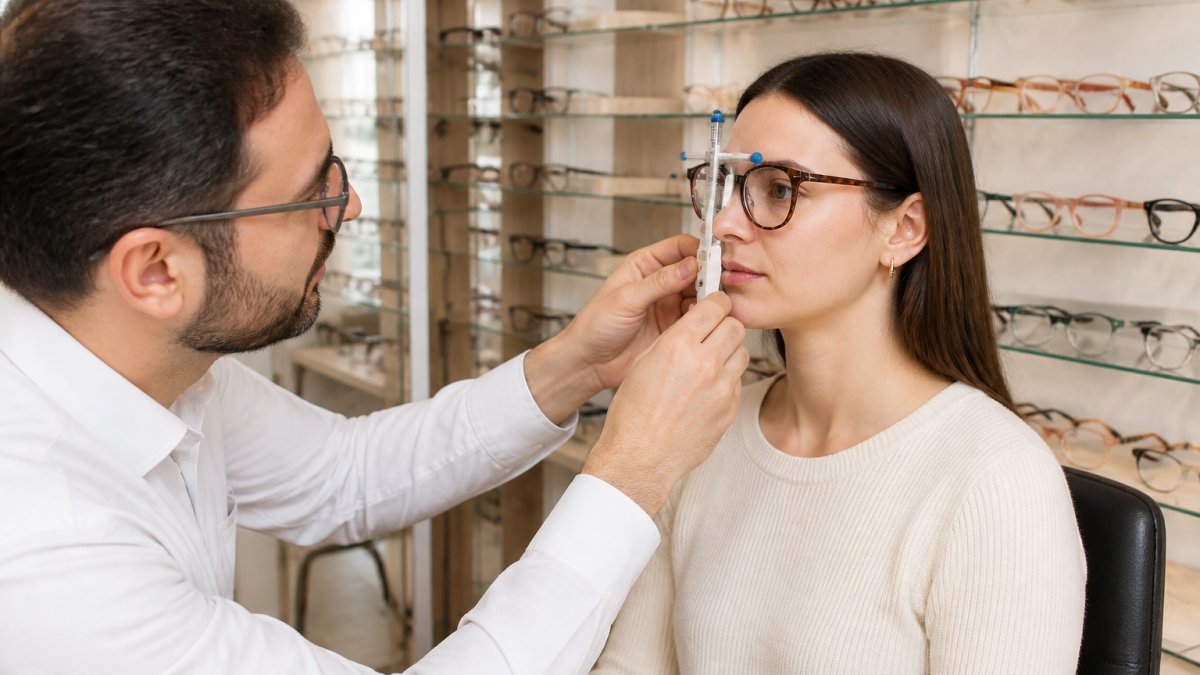
This is why we measure pupillary distance and fitting height with the frame on your face, not from a selfie. Posture, the frame's position on your nose, and bridge fit all shift the optical center; get those right and the lens performs as designed.
Progressive Lenses for Astigmatism: Managing Cylinder Power in the Corridor
Progressive lenses for astigmatism add a second variable: cylinder power and axis. Cylinder corrects the irregular curvature of the cornea and must stay aligned to the correct axis across the entire lens.
Two things help: a digitally surfaced design, cut to your exact prescription and frame position rather than ground from a stock blank, keeps the cylinder aligned more accurately through the corridor; and a slightly wider corridor reduces the swim effect astigmatic wearers notice when moving their eyes side to side.
If your cylinder is significant, expect a longer adaptation period than a sphere-only wearer. That is normal, not a sign the lens is wrong.
How to Adjust to Progressive Lenses Without the Dizzy Phase
Most wearers adapt to progressive lenses within one to two weeks, faster with a few habits. The dizziness people describe usually comes from looking through the wrong zone, not a defective lens.
- Wear the glasses full time for the first week. Switching back to old glasses resets your progress.
- Point your nose at what you want to see, then move your eyes. The corridor is narrow by design.
- Use the top of the lens for distance, the middle for computer work, and the bottom for reading.
- Practice the down-and-in reading motion at home before you need it in public.
- Avoid driving in the first day or two if the peripheral edges feel active.
If things still feel wrong after two weeks, the issue is usually fitting height, centration, or corridor length, not your ability to adapt. Bring the glasses back for a measurement check.
Jacques Marie Mage Tomlin Rx →
What Progressive Lenses Cost in 2026 and Where the Money Goes
Progressive lens pricing reflects four things: material index, design tier, coatings, and fitting accuracy. A basic stock 1.60 sits at the low end; a digitally surfaced 1.74 cut to your frame and measurements sits at the high end.
Typical Lens Price Ranges
Lens prices vary by provider and design, but the ranges below reflect what most optical shops charge for a single pair of progressive lenses in 2026. These are lens-only prices; frames are separate.
| Lens Type | Typical Price Range (Per Pair) | What You Get |
|---|---|---|
| Stock progressive, 1.60 | $150-$300 | Standard corridor, basic coatings |
| Stock progressive, 1.67 | $250-$450 | Thinner material, moderate customization |
| Digitally surfaced, 1.67 | $400-$700 | Free-form design, wider corridor, better centration |
| Digitally surfaced, 1.74 | $600-$1,000+ | Thinnest material, premium design, maximum customization |
These ranges are estimates and vary by region, provider, and brand. A premium progressive from a major manufacturer can exceed the top, while a warehouse club or online retailer may fall below the bottom.
What Drives the Cost
Material index. Higher-index materials cost more to produce because they require specialized manufacturing.
Design tier. Stock progressives are ground from a pre-made blank with a fixed corridor length and width.
Coatings. Anti-reflective, scratch-resistant, and blue-light coatings add to the price.
Fitting accuracy. This is the hidden cost driver. A premium lens that is poorly measured performs worse than a basic lens fitted correctly.
Frame Prices: A Reference Point
For frames, our own collection gives a sense of where premium eyewear lands. The Jacques Marie Mage Tomlin Rx is $870.00, the Akoni Europa Rx is $760.00, the Akoni Zenith is $710.00, the Akoni Juno - One Rx is $910.00, and the Akoni Cosmo Rx is $950.00. Lens pricing depends on the material and design you choose, and we quote it against your actual prescription and frame.


How to Think About Value
The cheapest progressive is rarely the best value for a strong prescription. A stock lens that saves $200 upfront but leaves a narrow corridor and constant swim effect is no bargain, and the most expensive lens is not automatically best if it is not fitted correctly. The best value matches your prescription, frame, and visual habits, fitted by someone who measures carefully and stands behind the work.
When a Strong-Prescription Progressive Needs a Remake
A remake is warranted when the lens is optically correct but physically wrong for your face. The most common triggers are a fitting height that sits too low, a frame that slides down your nose, a centration error, or a corridor length mismatched to how you use your eyes.
Some signs point to a remake, and some point to adaptation:
| Symptom | Likely Cause | Typical Fix |
|---|---|---|
| Blur only when reading | Fitting height too low | Raise fitting height |
| Pulling sensation at edges | Centration or prism error | Re-measure and re-surface |
| Frames slide down | Bridge or temple fit | Adjust frame, not lens |
| Dizzy for over two weeks | Corridor too short or narrow | Longer corridor design |
| Sharp color fringes | High index, low Abbe value | Step down to 1.67 |
Before requesting a remake, have the frame adjusted and measurements re-checked. Many problems resolve with a fit correction rather than new lenses.
A strong prescription narrows your margin for error, and that is where an experienced optical team earns its keep. At The Optical Shop of Manhasset, we handle complex prescriptions in our on-site laboratory, fit frames from independent designers including Jacques Marie Mage and Akoni, and measure centration and fitting height in person rather than guessing from a photo.
Frequently Asked Questions
What are the best progressive lenses for a strong prescription?
The best progressive lenses for strong prescriptions combine a high-index material with a digitally surfaced, customized design. High-index lenses (1.67 or 1.74) keep the lenses thinner and lighter, while digital designs widen the usable corridor and reduce peripheral distortion. A frame with adequate lens height and accurate centration matters just as much as the lens itself. Ask your optician to measure fitting height, pupillary distance, and optical center precisely before ordering.
Do high-index lenses work well with progressive lenses?
Yes. High-index progressive lenses are the standard choice for stronger prescriptions because the material bends light more efficiently, so less thickness is needed. The trade-offs are higher cost and slightly more chromatic aberration at very high indexes. For most wearers above roughly -4.00 or +3.00, the weight and cosmetic benefits outweigh those drawbacks. Your optician can match the index to your exact sphere, cylinder, and ADD power.
Are progressive lenses harder to adjust to with a strong prescription?
They can be. Stronger prescriptions amplify peripheral distortion and the swim effect at the edges of the lens, so the adaptation period often runs longer than for mild prescriptions. Most wearers settle in within one to two weeks of consistent wear. A customized digital design, accurate fitting height, and a frame that stays put on your face all shorten that timeline. If vision is still uncomfortable after two weeks, return for a recheck.
Can strong prescriptions cause distortion in progressive lenses?
Higher power does increase peripheral distortion because the lens surface curves more steeply from the distance zone through the corridor to the reading zone. Digitally surfaced and customized progressive lenses reduce this by optimizing the design for your exact prescription and frame. Choosing a frame with a shorter vertex distance and stable nose bridge fit also helps. Some adaptation is normal; persistent distortion usually signals a measurement or design issue worth rechecking.
Which frames are best for strong prescription progressive lenses?
Frames with a lens height of at least 30 millimeters give the progressive corridor room to work. Medium-width, rounded or soft-square shapes tend to distribute thickness more evenly than very large or very narrow frames. A frame that sits close to the eyes and grips the nose without sliding keeps the optical center aligned. For higher prescriptions, smaller frames reduce overall lens thickness and weight noticeably.
How long does it take to get used to progressive lenses?
Most wearers adapt within one to two weeks of full-time wear. The first few days often bring mild edge blur or a slight swim sensation when you move your eyes rather than your head. Strong prescriptions and first-time progressive wearers may need closer to two to three weeks. Wearing them consistently, pointing your nose at what you want to see, and avoiding switching back to old glasses speeds up the process.
Leave a comment