


Are On-Site Optical Labs Worth It?

Last Updated: October 25, 2026
Quick Summary
An on-site optical lab cuts, edges, and mounts your prescription lenses in the same building where your eyes were measured, compressing days of waiting into hours. The benefits come down to control: one team handles your measurements, lens specifications, and final fitting, so errors are caught and corrected in the same visit instead of triggering a shipped remake.
- In-house labs often turn orders around in hours to a few days, while outside labs usually take several days.
- Single-vision lenses in standard plastic or polycarbonate with modest prescriptions are most likely to qualify for same-day finishing.
- Coatings that require off-site application usually push an order past same day regardless of cutting speed.
- An on-site lab does not automatically make eyewear cheaper or more expensive; it changes where the work happens.
- Ask the optician to confirm in writing whether your specific lens is cut in-house or ordered.
Table of Contents
- What an On-Site Optical Lab Actually Changes
- What Does an Optical Lab Do?
- In-House Optical Lab vs. Outside Lab
- Same-Day Glasses: What's Realistic and What Isn't
- Eyeglass Lens Fitting and Adjustment: Why the Last Step Decides Comfort
- Costs, Insurance, and Urgent-Use Cases
- Questions to Ask Before You Choose a Provider
- What to Bring to Your Next Eye Exam and Fitting
- Frequently Asked Questions
What an On-Site Optical Lab Actually Changes
Most people assume their glasses travel to a distant facility after the exam. With an on-site optical lab, the prescription lenses are cut, edged, and mounted in the same building where your eyes were measured. Below, we break down how the process works, what can realistically be finished same day, and where the trade-offs sit. (Source: industry statistics on eyewear production timelines)
What Does an Optical Lab Do?
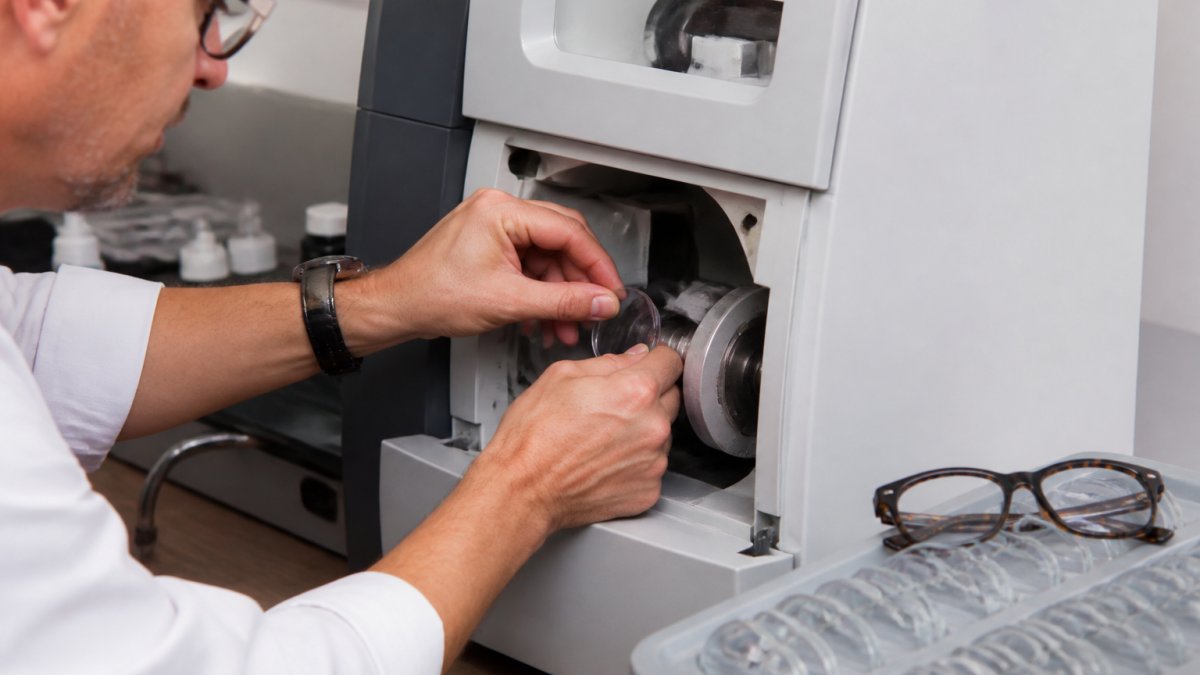
An optical laboratory is the production facility where a prescription becomes a physical lens. It receives your written prescription and frame measurements, selects the correct lens blank, then cuts, grinds, and finishes the lens to your exact specifications.
From Prescription to Finished Eyewear
The workflow is more involved than most patients realize. A lab technician translates your prescription into lens specifications, including material, index, coatings, and optical center. The lens is then cut to the frame's shape, edged, mounted, and inspected. Each stage depends on accurate frame measurements and lens alignment, which is why a lab that works directly with the dispensing optician catches errors earlier.
Where Quality Control Fits In
Quality control is where in-house labs earn their keep. A technician checks lens power, optical center placement, and edge finish before the glasses reach your hands. When a lens is produced on site, a problem gets caught and corrected in the same visit instead of triggering a remake that ships back and forth. Fewer shipping and handling steps also mean less chance of damaged lenses or damaged frames arriving at your door.
In-House Optical Lab vs. Outside Lab
The core difference between an in-house optical lab and an outside lab is distance and feedback speed. An outside lab may produce excellent work, but every question, correction, or rush order has to travel through a courier and a queue.
That control shows up in turnaround time and in how quickly adjustments get made. For a deeper look at how custom lenses compare to stock options, see our guide on why custom prescription lenses are better than stock.
| Factor | In-House Optical Lab | Outside Lab |
|---|---|---|
| Typical turnaround | Often hours to a few days | Usually several days |
| Quality control | Checked on site before pickup | Checked remotely, then shipped |
| Remakes and errors | Corrected in the same visit | Requires reshipping |
| Shipping and handling | Minimal | Multiple transit steps |
| Rush and urgent orders | Easier to prioritize | Depends on the lab's queue |
Same-Day Glasses: What's Realistic and What Isn't
"Same-day glasses" is a useful shorthand, but it is not a single service, it is a range of outcomes that depend on your prescription, the lens you choose, and the lab's capacity on the day you order. The most useful thing an on-site lab can do is tell you upfront which category your order falls into, rather than promising a timeline it cannot keep.
The Variables That Decide Your Turnaround
Four factors drive almost every same-day decision:
- Prescription power. Low-to-moderate single-vision prescriptions in the common range are the easiest to finish quickly because the lab can edge them from stock lens blanks. Higher powers, high astigmatism, and prism requirements often need surfaced or specially ordered blanks, which adds time.
- Lens material and index. Standard plastic and polycarbonate blanks are typically stocked on site. High-index materials, trivex in uncommon powers, and specialty substrates are more likely to be ordered, even at a lab with a deep inventory.
- Coatings and treatments. Anti-reflective coatings, scratch-resistant hard coats, photochromic treatments, and blue-light filters each add process steps. Some are applied and cured in-house; others are sent to a coating facility. A coating that requires off-site application will usually push an order past same day regardless of how fast the lab cuts the lens.
Prescriptions and Lens Types That Usually Qualify
In practice, the orders most likely to be finished the same day are single-vision lenses in standard plastic or polycarbonate, with a modest prescription and either no coating or an in-house hard coat. Many progressive lenses can also be completed quickly when the design is stocked and the prescription is within the lab's supported range. Our guide on progressive lenses for strong prescriptions explains why stronger prescriptions often need more time.
Limitations and Trade-Offs of an On-Site Lab
An on-site lab is a significant investment in equipment and skilled staff, and no single lab can stock every lens in every power. Specialty designs, certain high-index progressives, occupational or safety lenses with specific standards, and complex prism work, frequently still route to an external laboratory. A busy in-house lab also has a finite daily capacity, so "same day" is a goal for qualifying orders, not a guarantee for every order.
How to Set Expectations Before You Order
A short conversation before the order is placed prevents most disappointment. Confirm three things: whether your lens will be cut on site, what the realistic pickup window is for your specific coating and prescription, and what happens if the finished lens needs a remake. A provider that can answer all three without hedging is telling you something useful about how its lab actually operates.
Eyeglass Lens Fitting and Adjustment: Why the Last Step Decides Comfort
Eyeglass lens fitting and adjustment is the step that determines whether precision lenses actually feel right. Even a perfectly made lens will slide, pinch, or sit crooked if the frame is not adjusted to your face. (Source: consumer expectations for service delivery)
Frame fitting involves aligning the frame to your bridge, temples, and ears, then checking lens alignment against your pupils. If your glasses slide down, our guide on how to stop glasses sliding down your nose covers practical fixes.
Costs, Insurance, and Urgent-Use Cases
Cost is the question most patients ask first, and the honest answer is that an on-site lab does not automatically make eyewear cheaper or more expensive, it changes where the work happens and who absorbs the cost of a mistake. Understanding those mechanics is more useful than a single quoted figure, because two prescriptions rarely cost the same.
What Drives the Price of an In-House Lens
The price of a pair of glasses is built from four components: the frame, the lens material and design, the coatings and treatments, and the professional services (measurement, fitting, and adjustments). An on-site lab affects the third and fourth components most directly. Because the lab and the optician work in the same building, measurement errors and lens-to-frame mismatches are caught before a lens is cut, which reduces the number of remakes a practice has to absorb. That efficiency can show up as more competitive pricing on standard lenses, but it does not change the underlying cost of premium materials or specialty coatings.
How Vision Insurance Usually Interacts With an On-Site Lab
Most vision plans cover a routine eye examination and provide an allowance toward lenses or frames, with the patient paying the difference. The plan's coverage terms, not the location of the lab, determine what you owe. Two practical points are worth checking before your visit:
- In-network versus out-of-network. A practice with an on-site lab may be in network with some plans and not others. Confirm network status first, because it affects your reimbursement more than lab location does.
- Remake and warranty terms. Ask whether a remake caused by a prescription change or a lab error is covered, and whether the plan or the practice absorbs that cost. This is where an on-site lab can genuinely save you money, since a corrected lens can be produced without a shipping cycle.
Urgent-Use Cases Where an On-Site Lab Matters Most
Faster production matters most when a pair of glasses is not a convenience but a necessity. The situations that most often justify expedited service include:
- A cracked or broken lens with no usable backup pair, especially before a work commitment or travel.
- A lost or damaged frame where the prescription is still current and only the frame needs replacing.
- A first pair for a new prescription when driving or work safety depends on corrected vision.
In each case, the deciding question is whether the required lens can be cut from stock on site. A simple single-vision replacement often can; a specialty progressive or a lens requiring an off-site coating usually cannot, no matter how urgent the need. Ask the optician to confirm eligibility before you rely on a same-day promise.
A Practical Way to Compare Quotes
When comparing providers, ask each one to break the quote into frame, lens, coatings, and services, and to state separately any rush fee and the remake policy. A quote that separates those line items is easier to compare honestly than a single bundled price, and it makes clear whether the on-site lab is actually saving you money or simply saving you time.
Questions to Ask Before You Choose a Provider
Ask direct questions before committing. A provider with a real on-site lab can answer them without hesitation.
- Can you finish my specific prescription in-house, or does it go to an outside lab?
- What is the realistic turnaround for my lens type and coatings?
- How do you handle a remake or prescription error?
What to Bring to Your Next Eye Exam and Fitting
Bring your current glasses, even if the prescription feels outdated, so the optician can compare fit and lens specifications. Bring your vision insurance card and a list of any medications that affect your vision.
A recent prescription helps, but a current eye examination ensures your lenses match your eyes today. Accurate frame measurements taken in person beat guessing at numbers online.
Frequently Asked Questions
What does an optical lab do?
An optical lab turns a written prescription into finished prescription lenses. Technicians select the lens material, cut and edge the lens to match the frame, apply coatings, and check the result against your prescription and measurements. In an on-site optical lab, those steps happen in the same building as your eye exam and frame selection, so a technician can recheck measurements and catch a problem before you leave.
Can an on-site optical lab make same-day glasses?
Often yes, but not for every order. Single-vision prescriptions in common lens materials with standard coatings are the most likely to be finished the same day. Complex progressive designs, high-index materials, specialty coatings, and some strong prescriptions with astigmatism usually need more time because the lens has to be made to tighter specifications. Ask the provider to confirm timing for your exact prescription before you commit.
Does an on-site optical lab improve prescription accuracy?
It removes some of the places where errors creep in. With an outside lab, the order travels by courier and the finished glasses travel back, which adds handling steps and shipping delays. An on-site optical lab keeps the frame measurements, lens cutting, and final verification in one place, so a technician can re-measure and re-check alignment before you try the glasses on. It does not replace a careful eye examination, but it shortens the chain between measurement and finished eyewear.
Can an on-site optical lab repair eyeglasses?
Many on-site labs handle common repairs such as replacing screws, adjusting frames, and swapping lenses into an existing frame, and some can cut a replacement lens when one is damaged. What a lab can fix depends on the frame material, whether the part is available, and the equipment on hand. Call ahead with the frame brand and the problem so the team can tell you whether it can be handled in-house or needs to be sent out.
Choosing eyewear should not mean choosing between speed and precision. At The Optical Shop of Manhasset, our on-site optical laboratory, curated collection of independent designer frames, and expert repair services keep the whole process under one roof. Get started with The Optical Shop of Manhasset and see how precise, personally fitted eyewear changes your daily comfort.

Leave a comment