


A Guide to High Quality Progressive Lenses for Astigmatism

Last Updated: October 30, 2026
Quick Summary
High quality progressive lenses for astigmatism are digitally surfaced or freeform designs that build your cylinder correction and axis into the whole lens map, rather than layering it on a stock blank. Accurate monocular PD, fitting height, and frame-on-face measurements matter as much as the design itself.
- Cylinder strength, add power, and anisometropia drive most comfort differences in progressive lenses.
- If your cylinder is roughly 1.25 D or higher, ask whether the design is digitally surfaced or freeform.
- Normal adaptation fades over days of consistent full-time wear; stable or worsening distortion after a week needs a return visit.
- If symptoms persist past roughly two weeks, have your optician verify fitting height, monocular PD, tilt, and vertex distance.
- Higher-index materials keep strong prescriptions thinner and lighter, and anti-reflective coating is close to mandatory for screen-heavy days.
Table of Contents
- Why Astigmatism Changes What You Need From Progressive Lenses
- Digital Progressive Lenses and Freeform Surfacing Explained
- Progressive Lens Fitting Measurements That Decide Clarity
- Progressive Lenses for High Astigmatism: Prescription Thresholds and Design Trade-Offs
- The Progressive Lenses Adaptation Period and Troubleshooting Distortion
- Frame Selection, Lens Materials, and Coatings for Everyday Wear
- Objective Quality Criteria, Pricing, and Value in Progressive Lenses
- Booking a Progressive Lens Consultation and Fitting
- Frequently Asked Questions
Why Astigmatism Changes What You Need From Progressive Lenses
A progressive lens already asks a lot of the eye: three prescriptions in one lens, blended without visible lines. Add astigmatism and the challenge multiplies. Someone with a strong cylinder who tried high quality progressive lenses for astigmatism elsewhere may walk away with a lens that swims at the edges and blurs at the computer.
Here is the core tension most guides skip. Astigmatism requires cylinder correction at a specific axis, and that correction must hold steady across the entire lens. A progressive lens changes power as the eye moves down the corridor, so the cylinder must stay accurate in the distance, intermediate, and near zones simultaneously.
How Cylinder Correction and Axis Interact With Lens Zones
Cylinder correction is the lens power that compensates for the uneven curvature of the cornea or lens; axis is the angle, measured in degrees, at which that correction sits.
In a progressive lens, axis accuracy matters most in the periphery.
Freeform and digitally surfaced designs can build the astigmatic correction into the whole lens map rather than layering it on top.
Digital Progressive Lenses and Freeform Surfacing Explained
The practical difference for astigmatism is control. A conventional progressive has a corridor length and inset chosen by the manufacturer. A freeform lens lets the lab place the corridor, adjust the inset, and manage the cylinder across every zone.
If you want the deeper case for going custom over stock, our guide on why custom prescription lenses are better than stock walks through the manufacturing differences.
Progressive Lens Fitting Measurements That Decide Clarity
Progressive lens fitting measurements are the physical data that tell the lab where your eye actually sits behind the frame: fitting height, pupillary distance, pantoscopic tilt, and vertex distance. No lens design survives bad measurements.
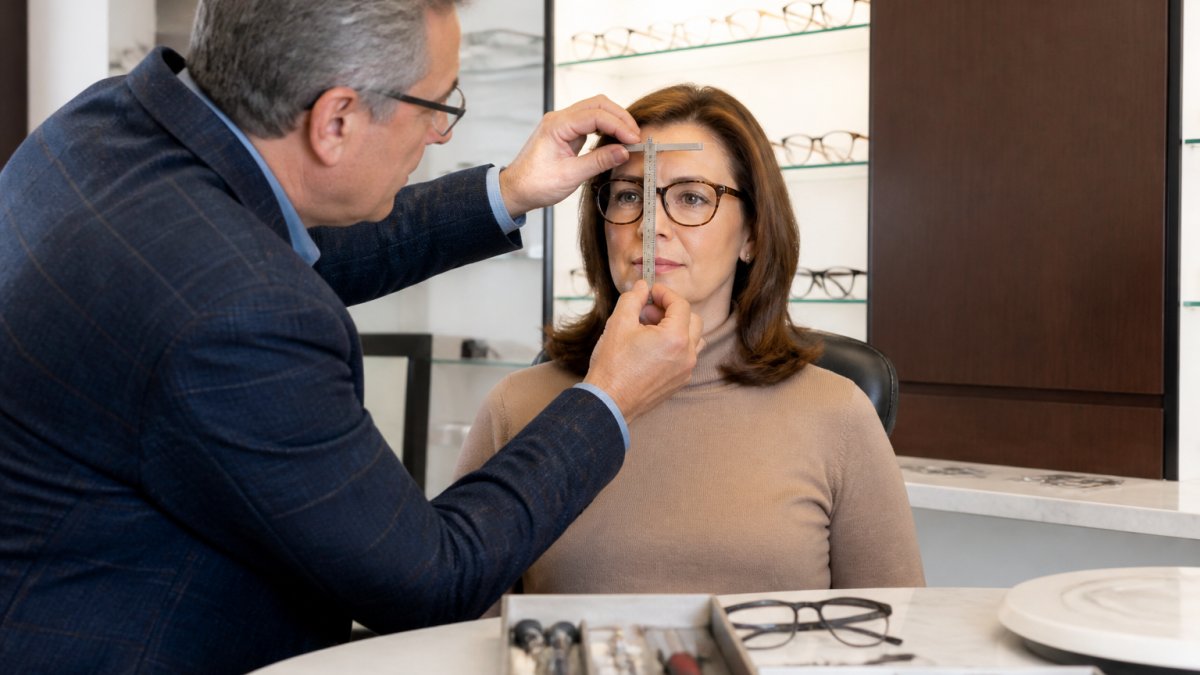
Fitting height is the vertical position of the pupil relative to the frame's bottom edge; it determines where the distance zone sits and how much corridor you get.
Fitting Height, Pupillary Distance, and Centration
Ordering a progressive with a single pupillary distance number and a guessed fitting height can cause problems. Monocular PD, measured per eye, is what a freeform design needs.
Watch out: a frame that slides down your nose changes your fitting height every time it moves. That is a frame-fit problem masquerading as a lens problem, and no lens upgrade fixes it.
Progressive Lenses for High Astigmatism: Prescription Thresholds and Design Trade-Offs
There is no universal cylinder cutoff where progressive lenses stop working, but the design trade-offs sharpen as cylinder rises. A progressive lens must blend a continuously changing spherical power (the add) with a fixed cylinder correction at a fixed axis.
Three prescription factors drive most of the comfort difference:
- Cylinder strength. Higher cylinder amounts make accurate centration, precise measurements, and the choice of surfacing more important. A qualified eye-care professional can advise where these thresholds fall for your prescription.
- Add power. A higher add compresses the intermediate and near zones and steepens the power gradient, the source of the "swim" and edge distortion astigmatic wearers report.
- Anisometropia (unequal power between eyes). Very different cylinder or sphere correction between eyes requires careful balancing; large differences increase prismatic imbalance and can make adaptation harder regardless of lens quality.
These are patterns, not rules. A qualified eye-care professional evaluates your full prescription, binocular vision, and lifestyle before recommending a design.
Comparing Lens Designs for Astigmatic Prescriptions
The useful comparison for astigmatism is not brand versus brand; it is design category versus design category, judged on usable viewing zones, peripheral distortion, fitting requirements, and trade-offs.
| Design | Corridor | Axis control across zones | Fitting data required | Best fit for astigmatism | Trade-off |
|---|---|---|---|---|---|
| Conventional stock progressive | Fixed, short to standard | Limited; cylinder can drift off-axis toward the periphery | Single PD and estimated fitting height often accepted | Low cylinder, occasional wear, budget priority | Narrower usable periphery; less tolerant of measurement error |
| Digitally surfaced standard | Adjustable | Good; cylinder calculated across the lens map | Monocular PD, fitting height, pantoscopic tilt, vertex distance | Moderate cylinder, daily wear, screen-heavy days | Requires accurate measurements; remake risk if data is estimated |
| Freeform personalized | Fully calculated per eye | Best; corridor, inset, and cylinder managed zone by zone | Full monocular measurements plus frame-on-face data | High cylinder, wide prescription range, first-time progressive wearers with strong cylinder | Higher cost, longer turnaround, dependent on optician skill |
The practical takeaway: as cylinder rises, the value shifts from the lens blank to the measurements and surfacing. For how these levers shift at higher spherical powers, the deeper guide on progressive lenses for strong prescriptions covers the power side of the equation.
The Progressive Lenses Adaptation Period and Troubleshooting Distortion
The progressive lenses adaptation period is the window in which the brain learns to ignore peripheral distortion and find the correct zone for each distance. Many wearers settle in over a period of consistent full-time wear.
Thom Browne Acetate Cateye Eyeglasses →
The key skill is distinguishing normal adaptation from a problem that will not resolve on its own. Adaptation discomfort generally fades over days of consistent wear, while a prescription, measurement, or frame-fit problem tends to persist or worsen.
Symptom-to-Cause Troubleshooting Guide
| Symptom | Likely cause | What to check |
|---|---|---|
| Distance vision blurry, near vision fine | Fitting height too low, or distance zone positioned wrong | Fitting height measured in the frame; frame sitting where it was measured |
| Reading requires head-tilting or chin-lifting | Near zone positioned wrong for your posture; corridor too short | Fitting height and corridor length versus frame depth |
| Floor curves or "swims" when walking | Peripheral design too aggressive, or corridor too short | Design category; whether a softer periphery or longer corridor is available |
| Edges skew or blur, especially with high cylinder | Axis drift in the periphery; measurement error; stock design limits | Monocular PD accuracy; whether the design is digitally surfaced |
| One eye comfortable, the other not | Anisometropia imbalance or a centration error in one lens | Monocular measurements per eye; prescription balance |
| Glasses slide down the nose through the day | Frame-fit problem masquerading as a lens problem | Bridge fit, temple adjustment, frame weight |
Normal Adaptation vs. a Problem That Needs a Return Visit
Normal adaptation has a recognizable shape: the swim at the edges diminishes over several days of consistent wear, the corridor becomes easier to find, and reading and distance vision improve together.
A common mistake is judging a new progressive in the first hour, or wearing it part-time and resetting the adaptation clock each time. Give it consistent full-time wear for several days before drawing conclusions.
When to Return to the Optician
Bring your current glasses in and ask for a measurement verification: fitting height, monocular PD, pantoscopic tilt, and vertex distance checked against what the lab used. If they match and symptoms persist, the conversation shifts to design, a longer corridor, a softer periphery, or a digitally surfaced or freeform lens that manages cylinder across every zone. If they do not match, the fix is a remake, not a new prescription.
Frame Selection, Lens Materials, and Coatings for Everyday Wear
Frame choice drives lens performance more than most wearers realize. A frame needs enough vertical depth to house the corridor, a bridge that holds position, and a shape that keeps the optical center where the lab expects it.
Material matters too. Higher-index materials keep strong prescriptions thinner and lighter, which improves comfort on the nose and reduces the prismatic effect at the edges.
If you are choosing frames now, our rundown of frame mistakes that blur astigmatism vision covers the fit errors we correct most often, and our reference on eyewear frame materials explains how acetate, titanium, and combination frames behave over time.
Objective Quality Criteria, Pricing, and Value in Progressive Lenses
Judging lens quality objectively means looking past the brand name on the envelope. The criteria that matter: whether the design is freeform or stock, the accuracy of the surfacing, the coating package, the warranty terms, and whether the measurements were taken by a qualified optician or estimated.
Pricing follows the same logic. A stock progressive costs less because less work goes into it. A digitally surfaced or freeform lens costs more because it is calculated and cut for one eye.
Value, in our view, is a lens you wear comfortably for two years rather than one you replace in frustration after three months. Our frame collection includes the Thom Browne titanium rectangular eyeglasses at $763, made in Japan from titanium with anti-reflective lenses, and the Thom Browne acetate and titanium rectangular eyeglasses at $850, made from 18k gold-plated titanium and Japanese acetate.


Booking a Progressive Lens Consultation and Fitting
A proper consultation covers four things: a current refraction, monocular PD and fitting height measured in the frame you will wear, a conversation about how you use your eyes, and an honest discussion of design options for your cylinder. Skipping any one is how good lenses end up in a drawer.
At The Optical Shop of Manhasset, our on-site optical laboratory surfaces precision-crafted prescription lenses, and we carry a curated collection of independent eyewear designer frames.
Frequently Asked Questions
Can you wear progressive lenses if you have astigmatism?
Yes. Progressive lenses can correct astigmatism alongside presbyopia, but the cylinder and axis values have to be built into every zone of the lens. Higher cylinder amounts narrow the usable viewing area, so the design and centration matter more than they do for a simple distance prescription. A proper fitting and an accurate prescription are what keep the lens comfortable rather than distorted.
What should I look for in progressive lenses for astigmatism?
Look for a lens design matched to your cylinder power, an accurate fitting height and pupillary distance, and a corridor length that suits how you use your eyes. Digitally surfaced lenses let the lab compensate for astigmatic error across the whole lens surface. Ask how the lens is centered and whether the design is customized to your frame before you commit.
Are premium progressive lenses better for astigmatism?
Premium designs usually widen the usable viewing area and reduce peripheral distortion, which matters most when cylinder correction is strong. The gain comes from freeform surfacing and personalized centration, not from the price tag alone. A well-fitted mid-range lens can outperform a premium lens that was measured poorly, so fitting accuracy comes first.
Why can progressive lenses feel blurry at the sides?
The periphery of any progressive lens contains unwanted astigmatism that increases toward the edges of the lens. Your brain learns to ignore it, but strong cylinder prescriptions make that zone larger and harder to tolerate. Wider corridor designs and precise centration shrink the problem. If side blur persists past the adaptation period, the fitting or design likely needs review.
How long does it take to adjust to progressive lenses?
Most wearers settle in within one to two weeks of consistent wear. Astigmatic prescriptions and first-time progressive wearers often sit at the longer end. Wear them steadily rather than switching back to old glasses, and avoid judging them on day one. If discomfort, eye strain, or distortion continues past a few weeks, return for a recheck of measurements and design.
Do progressive lenses for astigmatism need special measurements?
They need the same core measurements as any progressive lens, done carefully: fitting height, pupillary distance, pantoscopic tilt, and vertex distance. Astigmatism adds a reason for precision, because a lens that is decentered or tilted will blur differently in each meridian. Personalized freeform designs use these measurements to compensate, which is why an in-person fitting beats a self-measured online order.
Astigmatism does not have to mean compromised vision in a progressive lens. It means the lens has to be designed, measured, and fit with more care. Get started with The Optical Shop of Manhasset and experience progressive lenses built around your prescription, your frames, and the way you actually see.

Leave a comment