


7 Frame Mistakes That Blur Your Astigmatism Vision

Last Updated: October 26, 2026
Quick Summary
Choose frames for astigmatism that keep your cylindrical lens centered and stable: a smaller frame with lens height under about 40mm, a keyhole or adjustable nose pad bridge, and a slight wrap rather than a deep or oversized shape. Frame geometry, not style, holds your axis correction in place and prevents blur, eye strain, and headaches.
- Vertex distance typically measures 12-14 mm in a well-fitted frame and changes the lens's effective power.
- Pantoscopic tilt usually sits at about 8-12 degrees and affects where the cylinder axis lands.
- Once CYL passes 2.00, choose acetate or thick rims and smaller lens widths to mask edge thickness.
- For high-cylinder progressives, look for a lens height of roughly 30-38 mm.
- A 46-48 mm lens width shows less edge thickness than a 52 mm lens in a high-cylinder prescription.
Table of Contents
- Why Frame Choice Matters More With Astigmatism
- Start With Your Prescription, Not the Frame
- The Best Frame Shape for Astigmatism: Geometry Over Style
- Choosing Frames for High Astigmatism Prescription
- How Frame Size Affects Astigmatism Glasses Lens Thickness
- A Frame-Fitting Checklist for Astigmatism
- In-Person vs Online Fitting: What Changes With Astigmatism
- Book a Fitting With The Optical Shop of Manhasset
- Frequently Asked Questions
Why Frame Choice Matters More With Astigmatism
Astigmatism is a refractive error caused by an uneven curve in the cornea or lens, which bends light unevenly and creates blurred or distorted vision at every distance (Astigmatism).
That is the part most buying guides skip. They treat frame shopping as a style decision. With astigmatism, it is a positioning decision first.
A frame that sits too low, slides forward, or tilts off-axis throws your cylinder correction out of alignment.
Start With Your Prescription, Not the Frame
The right frame for astigmatism is the one that keeps your lens centered and stable, so read your prescription before you look at a single frame. Your eyeglasses prescription carries three numbers per eye: sphere (SPH), cylinder (CYL), and axis. The American Optometric Association's guide to reading a prescription explains each value in plain terms.
Reading the CYL and Axis Values
CYL is the amount of astigmatism correction, written as a negative number. Axis is the angle of that correction, from 1 to 180 degrees. A prescription of -1.50 CYL at 180 is a different lens from -1.50 CYL at 90.
Axis is the number that makes frame fit matter. Rotate the lens even a few degrees and the correction lands on the wrong meridian of your eye.
What Your Numbers Mean for Frame Size
Frame size is printed inside the temple arm as three numbers, such as 52-18-145. That means lens width, bridge width, and temple length in millimeters. Your pupillary distance (PD) tells the lab where to center each lens.
A frame that is too wide for your PD forces the lens to be decentered, which adds thickness at the edges. If your face is on the smaller side, our guide to petite frames for small faces shows how to match those measurements before you commit.
The Best Frame Shape for Astigmatism: Geometry Over Style
The best frame shape for astigmatism is a smaller, well-centered frame with a stable bridge, because less lens area and a firm fit keep the cylindrical correction aligned.
Here is what to look for:
- Lens height under about 40mm keeps the optical center close to your pupil.
- A keyhole or adjustable nose pad bridge stops the frame sliding down.
- A slight wrap or curve can help, but too much wrap distorts the axis.
A common mistake is choosing a bold, oversized frame because it looks striking in the mirror. In practice, a deep lens pushes the optical center far from your eye and adds edge distortion.
The Four Geometry Variables That Actually Matter
Frame geometry affects an astigmatism correction through four measurable variables. None of them is about shape.
1. Vertex distance. This is the gap between the back of the lens and the front of your eye, typically 12-14 mm in a well-fitted frame.
2. Pantoscopic tilt. This is the angle of the frame front relative to vertical, usually about 8-12 degrees.
3. Optical-center alignment. The optical center of each lens should sit in front of your pupil when you look straight ahead.
**4.
Why Frame Shape Is Secondary
Once the four variables above are controlled, shape becomes a style decision. Round, square, cat-eye, and rectangular frames can all hold an astigmatism correction well if the lens size, bridge, and tilt are right. The shapes to approach with caution are the ones that force a large lens or a deep lens: oversized aviators, deep rectangles, and very wide frames. They are not forbidden, they just demand more from the lens design and the fitting.
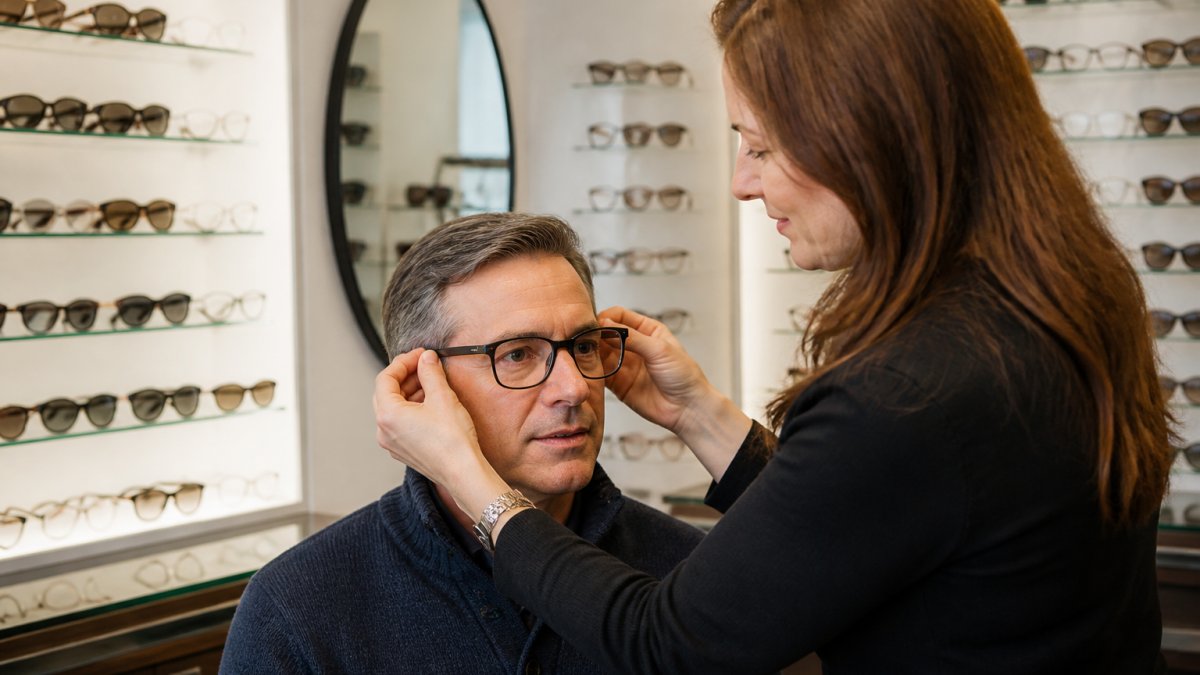
A slipping frame ruins axis alignment, so it is worth fixing. Our guide on how to stop glasses sliding down your nose covers the adjustments that solve it.
Choosing Frames for High Astigmatism Prescription
For a high astigmatism prescription, frame choice narrows fast: pick a small, sturdy frame with thick rims, and expect lens thickness to drive the decision. The higher your cylinder, the more the lens edge distorts and thickens, and the less tolerance the frame has for sitting off-center.
When Your Cylinder Is Above 2.00
Once CYL passes 2.00, edge thickness and weight climb quickly. A thin metal rim will not hide it. Look for:
- Acetate or thick-rimmed frames that mask edge thickness
- Smaller lens widths, which cut overall lens mass
- A frame with a solid bridge and firm temples
Custom lens design also matters here. Stock lenses are cut to a limited range of curves; custom lenses are surfaced to your exact axis and power, which keeps a strong prescription clearer. Our team explains why custom prescription lenses outperform stock lenses for complex prescriptions.
High Cylinder Plus Progressive Lenses
If you wear progressives and have a strong cylinder, frame height becomes a hard constraint, not a preference. A progressive lens needs enough vertical room for the distance, intermediate, and near zones, and a high-cylinder design needs the optical center placed precisely. In practice, most practitioners look for a lens height of roughly 30-38 mm for a progressive, enough for the corridor without pushing the optical center too far from the pupil.
Anisometropia and Unequal Prescriptions
When the two eyes need very different correction, a condition called anisometropia, frame symmetry matters more than style. A frame that sits crooked or slides to one side will make the stronger eye work harder and can trigger headaches or double vision. Look for adjustable nose pads and temples you can bend, and have the frame fitted so both lenses sit at the same height and tilt.
Prism and Other Add-Ons
Some astigmatism prescriptions also include prism to correct eye alignment. Prism is ground into the lens at a specific base direction, and it is sensitive to how the lens sits in the frame. A frame that rotates or slides will shift the prism effect. If your prescription includes prism, choose a frame with a firm bridge and temples that hold position, and have the optical center verified after the lenses are mounted.
What High Cylinder Means for Frame Size
A useful rule of thumb: the higher the cylinder, the smaller the frame should be. A 52 mm lens width in a high-cylinder prescription will show more edge thickness and more peripheral distortion than a 46-48 mm lens in the same prescription. If you love a larger shape, ask whether a high-index material and a custom-surfaced lens can offset the trade-off, and expect the answer to depend on your exact CYL and axis.
How Frame Size Affects Astigmatism Glasses Lens Thickness
Astigmatism glasses lens thickness depends on three things: your prescription strength, the lens material, and how large the frame is. A bigger frame means a bigger lens blank, and the edges get thicker as the lens widens.
So the frame you fall in love with can add visible thickness and weight. Two fixes:
- Choose a high-index lens material to keep the profile slim.
- Keep the frame modest in size so less lens is needed.
Readers weighing strong prescriptions will find more detail in our guide to progressive lenses for strong prescriptions, which covers how lens design and frame size interact.
A Frame-Fitting Checklist for Astigmatism
Use this checklist before you commit to any pair. It takes two minutes and catches most fit problems.
- Check the bridge. The frame should sit on your nose without pinching or sliding.
- Look at your pupils. They should sit near the horizontal center of each lens, slightly above the midline.
- Nod firmly. If the frame slides, the fit is wrong.
- Look down and up. The frame should not press your cheeks or lift your brows.
- Check the tilt. The frame front should sit close to vertical, not angled back.
- Feel the temples. Firm behind the ears, no pressure points.
- Confirm the width. The frame should follow your face width, not overhang it.
A slipping frame ruins axis alignment, so it is worth fixing. Our guide on how to stop glasses sliding down your nose covers the adjustments that solve it.
In-Person vs Online Fitting: What Changes With Astigmatism
Online ordering works well for simple prescriptions. With astigmatism, it carries real risk, because axis alignment and optical centering are exactly what a remote process cannot check.
Here is the honest comparison:
| Factor | In-Person Fitting | Online Ordering |
|---|---|---|
| Axis alignment check | Measured and adjusted | Not verified |
| PD measurement | Taken directly | Self-measured, error-prone |
| Frame fit on your face | Tried on and adjusted | Guessed from photos |
| Lens centering | Set to your frame | Limited control |
| Adjustments after delivery | Done on site | Mail-back or none |
What most guides miss is that the frame and the lens are a system. A lab can only center a lens correctly if the frame is measured on your face. At The Optical Shop of Manhasset, our on-site laboratory cuts lenses to the frame as fitted, which removes the guesswork for stronger prescriptions.
Book a Fitting With The Optical Shop of Manhasset
Getting your astigmatism correction to sit still is not something you can solve by reading frame measurements alone.
That is what we do. Our boutique pairs comprehensive eye exams with precision-crafted lenses from our on-site laboratory, and our independent eyewear collection includes frames in the smaller, stable shapes that strong prescriptions need.
Get started with The Optical Shop of Manhasset and find frames that keep your vision sharp, stable, and comfortable all day.
Frequently Asked Questions
What frame shape is best for astigmatism?
A frame with a small-to-medium lens height and a shape that keeps the optical center close to your pupil works best. Round and oval shapes with a shallow lens depth reduce edge distortion, while very deep or oversized lenses can make thick edges more noticeable. The best frame shape for astigmatism is the one that fits your face and your prescription numbers, not the one that simply looks trendy. Bring your prescription to the fitting so the optician can match shape to your CYL and axis values.
Do larger frames make astigmatism lenses thicker?
Yes. A larger lens blank has to cover more surface area, so the edges get thicker, especially when your prescription has a high cylinder or sphere value. Astigmatism glasses lens thickness depends on your prescription strength, lens material, and frame size. Choosing a frame with a smaller lens width and a thicker rim can hide edge thickness and keep the finished glasses lighter. Ask your optician to show you the same prescription in two different frame sizes so you can see the difference before you commit.
Can the wrong frames affect how well astigmatism glasses work?
They can. If a frame sits too low, slides down your nose, or puts the optical center away from your pupil, you may notice blurred vision, eye strain, or headaches even though the prescription is correct. Frames for astigmatism need a stable bridge, proper temple length, and a lens size that matches your pupillary distance. A frame that moves throughout the day forces your eye to constantly re-adapt, which is especially noticeable with higher cylinder values. A professional fitting catches these problems before the lenses are cut.
Should I choose glasses or contact lenses for astigmatism?
Both can correct astigmatism, but the right choice depends on your prescription, lifestyle, and comfort. Glasses are a low-maintenance option and work well for high cylinder values that are harder to fit in soft contact lenses. Toric soft contact lenses and rigid or scleral lenses are options for people who prefer not to wear frames. Many people keep a pair of glasses as a backup even if they mainly wear contacts. An eye-care provider can compare your options and check how well each correction works for your visual tasks.

Leave a comment